

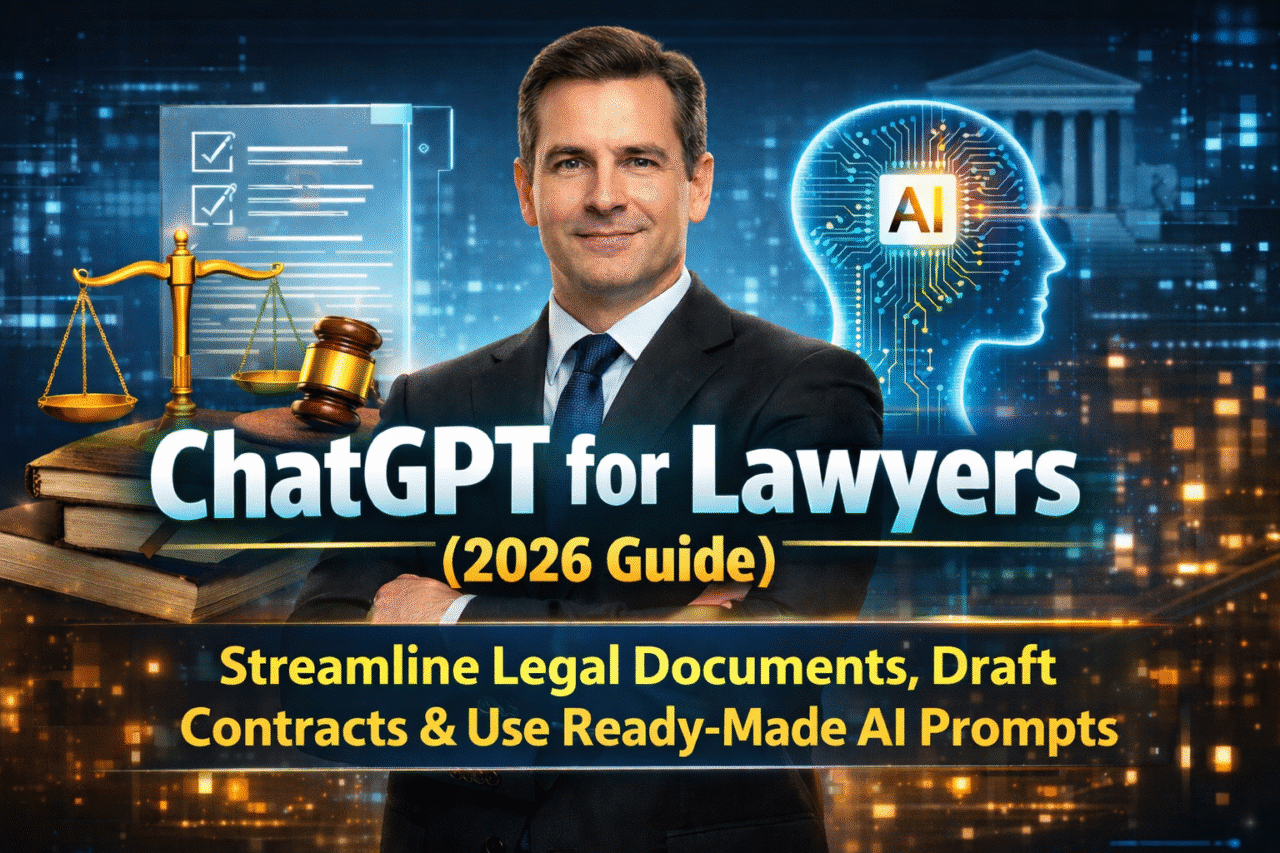
Chatgpt For Lawyers: Discover how lawyers can use ChatGPT for legal documents in 2026. Draft contracts, research cases, avoid AI risks & use 10+ legal-safe prompts.
Why ChatGPT for Lawyers Is Exploding in 2026
Artificial intelligence is no longer a “future trend” in the legal industry, It is already reshaping how law firms operate. In 2026, ChatGPT for lawyers has become one of the most searched and discussed topics on Google, ChatGPT, and legal tech forums worldwide.
From drafting contracts in minutes to summarizing complex case law, ChatGPT is now widely used as a legal productivity assistant, not a replacement for lawyers but a powerful tool that dramatically reduces repetitive work.
However, this power comes with responsibility. AI can hallucinate legal citations, mishandle sensitive information, or introduce bias if used blindly. That’s why understanding how lawyers should use ChatGPT correctly, ethically, and safely is critical in 2026.
This guide explains exactly how ChatGPT helps lawyers, what risks to avoid, and provides 10+ legally structured prompts that attorneys can adapt immediately for real-world use.
What Is ChatGPT for Lawyers?
ChatGPT for lawyers refers to the use of OpenAI’s conversational AI as a legal assistant to support:
- Drafting legal documents
- Summarizing case files
- Conducting preliminary legal research
- Improving client communication
- Automating routine administrative work
ChatGPT does not practice law, give binding legal advice, or replace professional judgment. Instead, it acts as a first-draft generator and research companion, accelerating workflows when used under human supervision.
Why ChatGPT Is Trending Among Lawyers?
| Time Efficiency | Reduces drafting time from hours to minutes |
| Cost Savings | Lowers paralegal and admin workload |
| Document Speed | Instantly creates structured drafts |
| Cognitive Relief | Handles repetitive mental tasks |
| Global Practice | Helps multilingual & international firms |
Legal professionals are now expected to do more work, faster, with fewer resources. ChatGPT fits perfectly into this demand.
Video Source: Texas Bar Practice
Key Uses of ChatGPT in Legal Practice (2026)
- Legal Document Drafting
ChatGPT excels at generating first drafts for:
- Contracts
- NDAs
- Demand letters
- Employment agreements
- Privacy policies
Lawyers should always review, edit, and validate the output before use.
2. Legal Research & Case Law Summaries
ChatGPT helps lawyers:
- Understand unfamiliar legal concepts
- Identify relevant statutes
- Summarize case holdings and reasoning
Important: AI may invent citations. Always cross-check with Westlaw, LexisNexis, or official court databases.
3. Case Analysis & Issue Spotting
For lengthy case files, ChatGPT can:
- Extract key facts
- Identify legal issues
- Summarize procedural history
- Highlight risks and arguments
This is especially useful for early case evaluation.
4. Client Communication & Law Firm Marketing
ChatGPT assists with:
- Client emails
- Blog posts & newsletters
- Legal explanations in plain English
- Social media updates for law firms
This improves clarity while maintaining professionalism.
5. Productivity & Workflow Automation
By automating routine tasks, lawyers can focus on:
Risks & Ethical Considerations Lawyers Must Know
AI Hallucinations (Biggest Risk)
ChatGPT can generate confident but false information, including:
- Fake case citations
- Non-existent statutes
- Incorrect legal standards
Solution: Treat AI output as a draft, not authority.
Confidentiality & Client Data Protection
Entering sensitive client information into AI tools may violate:
- Attorney-client privilege
- GDPR
- Bar association rules
Best Practice:
- Remove personal identifiers
- Use anonymized facts
- Follow your jurisdiction’s AI ethics guidelines
Bias in AI Outputs
AI models are trained on public data that may contain:
- Racial bias
- Gender bias
- Jurisdictional bias
Lawyers must apply independent judgment at all times.
ChatGPT Is NOT a Lawyer
ChatGPT cannot:
- Appear in court
- Give binding legal advice
- Replace legal expertise
It is a tool, not a decision-maker.
Most Viral: How To Create Unlimited AI Videos In 2026
10 Professional Prompts For ‘ChatGPT for Lawyers’
Below are carefully structured, legal-safe ChatGPT prompts designed for lawyers. These prompts are intended for drafting assistance and preliminary analysis only and must always be reviewed by a licensed attorney.
1. Contract Drafting Prompt
Draft a preliminary service agreement between two parties under [jurisdiction],
including scope of services, payment terms, confidentiality, limitation of liability,
and termination clauses. Leave placeholders where legal review and jurisdiction-specific
customization are required.
2. Non-Disclosure Agreement (NDA) Prompt
Create a standard non-disclosure agreement suitable for early-stage business discussions.
Include definitions, obligations of confidentiality, exclusions, duration, and remedies.
Note that jurisdiction-specific legal review is required before use.
3. Case Summary & Issue Identification Prompt
Summarize the following case facts and identify the key legal issues, claims, defenses,
and procedural posture. Do not provide legal conclusions or fabricate case law.
4. Legal Research Starter Prompt
Provide an overview of the general legal principles related to [legal topic] under
applicable law. This is for preliminary research only. Do not generate fabricated
citations or legal authorities.
5. Client Communication Email Prompt
Draft a professional and client-friendly email explaining the general legal process
for [legal issue] in plain English. Avoid providing legal advice, predictions, or guarantees.
6. Demand Letter Drafting Prompt
Generate a professional demand letter requesting resolution of a commercial dispute.
Maintain a neutral tone, avoid admissions of liability, and include a clear response deadline.
7. Legal Issue Spotting Prompt
Review the following fact pattern and list potential legal issues that should be
examined by an attorney. Do not provide legal opinions or conclusions.
8. Employment Agreement Outline Prompt
Draft a general outline for an employment agreement including compensation, duties,
confidentiality, non-compete, termination, and dispute resolution sections.
Mark areas requiring legal customization.
9. Discovery Document Summary Prompt
Summarize the following discovery documents into key facts, timelines, inconsistencies,
and notable points for attorney review. Do not interpret or speculate beyond the content.
10. Cross-Border Legal Considerations Prompt
Explain the general legal considerations involved in cross-border contracts between
[Country A] and [Country B] at a high level. Do not provide jurisdiction-specific legal advice.
Sources & References (Verified & Trusted)
- OpenAI – ChatGPT Capabilities & Limitations
- American Bar Association (ABA) – AI Ethics in Legal Practice
- Thomson Reuters – Legal AI & Automation Reports
- Harvard Law Review – Artificial Intelligence and the Law
- Law Society Guidelines on AI Usage
(All sources publicly available and widely cited in legal tech research)







Leave a comment