

New Google AI Shopping Agent 2026: How Agentic Commerce, Gemini, and UCP Are Changing Retail
Google AI Shopping Agent 2026: How Agentic Commerce, Gemini, and UCP Are Changing Retail
Online shopping has spent two decades optimizing search, filters, and recommendations. Google’s latest move signals a deeper shift. Instead of helping users browse better, Google is building systems that can act on shopping intent directly.
With the launch of its AI Shopping Agent, the Universal Commerce Protocol (UCP), and expanded Gemini integrations, Google is restructuring how commerce operates across discovery, purchasing, and post-purchase support.
What Agentic Commerce Means in Practical Terms
Agentic commerce refers to AI systems that can reason, plan, and execute actions once a user provides intent and approval. This goes beyond conversational assistants or product suggestions.
In an agentic system, AI can:
- Interpret high-level shopping intent instead of keyword queries
- Compare products across retailers automatically
- Build carts and complete purchases with consent
- Handle changes, returns, and support without repeated prompts
Google Cloud describes this transition as moving commerce from passive browsing to active execution, where AI performs the operational steps that usually slow consumers down.
Source: Google Cloud – A New Era of Agentic Commerce
The Universal Commerce Protocol (UCP): The Infrastructure Layer
The Universal Commerce Protocol is the foundation that allows agentic commerce to function at scale. UCP is an open standard designed to let AI agents communicate with retail systems using a shared operational language.
Before UCP, every AI assistant required custom integrations with each retailer, payment provider, and fulfillment system. UCP removes that fragmentation by standardizing how actions such as product discovery, checkout, and payment authorization are handled.
UCP is compatible with existing industry protocols including Agent2Agent (A2A), Agent Payments Protocol (AP2), and Model Context Protocol (MCP), which allows businesses to adopt it without replacing existing infrastructure.
UCP was co-developed with major retailers and platforms including Shopify, Walmart, Target, Etsy, and Wayfair, and endorsed by payment networks such as Visa, Mastercard, Stripe, and American Express.
Source: Google Ads & Commerce Blog – Agentic Commerce and UCP
How the Gemini AI Shopping Agent Works
Gemini’s shopping agent is designed as a multimodal reasoning system. It processes natural language, images, contextual signals, and linked account data to resolve shopping tasks.
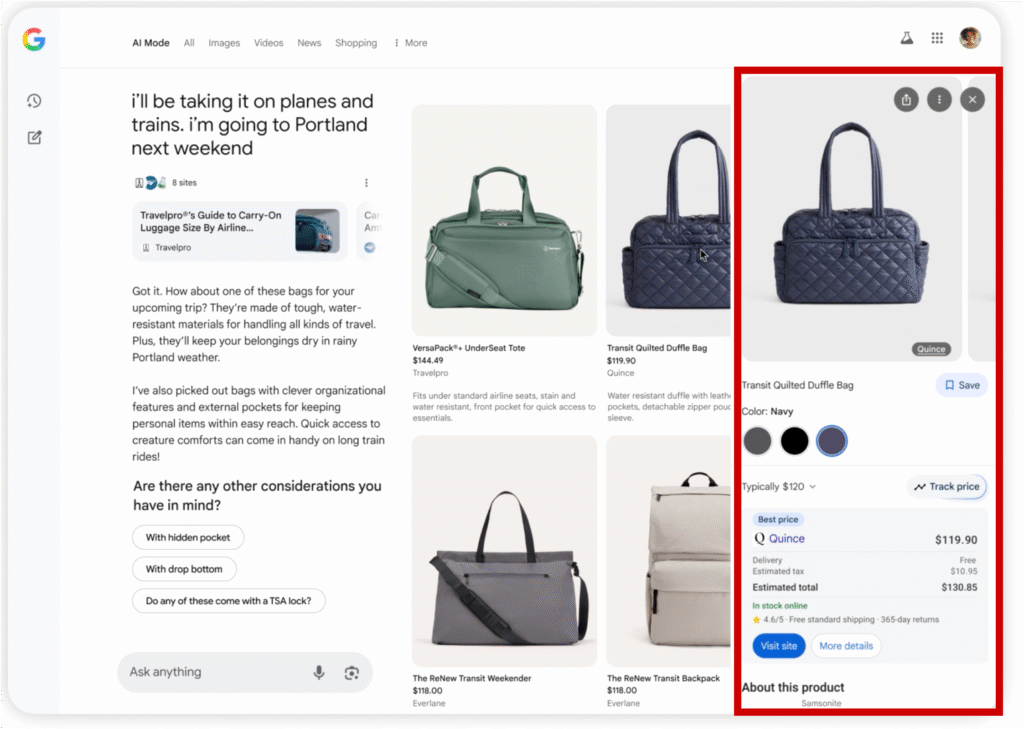
Rather than returning a list of links, Gemini can perform actions such as:
- Identifying suitable products across multiple retailers
- Evaluating trade-offs like price, availability, and delivery speed
- Assembling shopping carts automatically
- Executing purchases after user approval
Google positions Gemini as an operational layer for commerce, meaning the system is built to complete tasks rather than guide users through interfaces.
Latest: Midjourney Niji V7 – Best Anime AI Model + 20 Free Prompts
Google and Walmart Partnership: Why It Signals Scale
In early 2026, Google and Walmart announced an integration that brings Walmart and Sam’s Club products directly into Gemini for users in the United States, with international expansion planned.
Through this partnership:
- Gemini recommends Walmart products when relevant to user intent
- Users can link their Walmart accounts for personalized suggestions
- Recommendations include both online and in-store inventory
Importantly, Walmart developed this experience using the Universal Commerce Protocol, rather than relying on a closed Google system. This shows how large retailers can retain control while still participating in agentic commerce.
Source: 9to5Google – Google and Walmart AI Shopping Partnership
Search Is Being Abstracted, Not Replaced
Agentic commerce does not remove search. It changes how search intent is expressed and resolved.
Instead of issuing detailed product queries, users describe goals. The AI agent interprets those goals and executes the required steps. Search becomes an internal process handled by the system rather than a visible action taken by the user.
This shift places greater importance on structured, accurate, and trustworthy content that AI systems can interpret reliably.
Gemini Enterprise for Customer Experience (CX)
Alongside its shopping agent, Google introduced Gemini Enterprise for Customer Experience, a platform that combines shopping and customer support into a single AI-driven workflow.
The platform includes autonomous agents capable of managing:
- Product discovery and ordering
- Order modifications and issue resolution
- Escalation to human representatives when needed
- Continuous learning from resolved interactions
Retailers currently using Gemini Enterprise for CX include Kroger, Lowe’s, Papa John’s, and Woolworths.
Source: Google Cloud – Gemini Enterprise for CX
Retail Market Response and Industry Adoption
The market response to Google’s agentic commerce initiative has been immediate. Wayfair’s stock rose following its participation in the AI shopping protocol, reflecting investor confidence in this model.
Source: Investing.com – Wayfair and Google AI Shopping
Why Content Structure Matters in Agentic Commerce
As AI systems increasingly interpret and act on user intent, content clarity becomes critical. Pages that clearly explain entities, relationships, and processes are more likely to be trusted by AI systems.
Websites that maintain transparent navigation, clear informational hubs, and accessible internal linking provide stronger signals for both users and AI agents.









Leave a comment