

ChatGPT vs Google Gemini: Ultimate AI Comparison 2026
Artificial intelligence tools have transformed how we work, learn, and create. In 2026, two AI systems lead the conversation: OpenAI’s ChatGPT models and Google’s Gemini suite. Both are powerful, but their strengths and usage differ in meaningful ways. This comparison breaks down their capabilities, data sources, real performance, pricing, and everyday use cases in a clear, straightforward way that anyone can follow. Users actually want to know in ChatGPT vs Google Gemini Which AI Tool Actually Delivers Better Results?
What Is ChatGPT?
ChatGPT is OpenAI’s conversational artificial intelligence platform designed to understand and generate human-like text. It can answer questions, write articles or emails, code, summarize content, plan projects, and much more. ChatGPT’s design prioritizes natural dialogue and detailed explanations that feel like talking with a knowledgeable assistant.
In 2026, the latest widely available models include GPT-5.1 and the newer GPT-5.2 Instant variant, which powers various ChatGPT subscription tiers. GPT-5.2 Instant is available through a low-cost “ChatGPT Go” tier that provides a larger number of messages, basic image generation, and extended context compared to the free tier. Ads are now introduced in the ChatGPT Go tier in the U.S., differentiating it from paid ad-free plans.
ChatGPT stands out for natural writing style, detailed explanations, and broad practical applications, making it a popular choice for writers, students, and professionals who need polished, readable content.
Latest: ChatGPT Ads Eligible Countries
What Is Google Gemini?
Google Gemini is Google DeepMind’s advanced artificial intelligence system designed from the ground up to process text, images, video, and audio in a truly multimodal way. It powers Google’s AI features across Search, Docs, Gmail, and Workspace tools, enabling users to interact with AI deeply connected to real-world data and Google’s ecosystem.
The most advanced version currently widely referenced is Gemini 3 Pro, released in late 2025 and rolling into 2026. Gemini 3 Pro has achieved high benchmark scores in reasoning, language understanding, and multimodal tasks. It also supports features like “Personal Intelligence,” which can securely integrate personal data from Gmail, Photos, Search, and YouTube to provide much more contextual and personalized AI assistance though this feature is opt-in and respects privacy controls.
Google has emphasized Gemini’s native multimodal architecture, which means it can directly interpret visual and auditory input alongside text rather than relying on separate modules. This makes it strong for tasks like summarizing diagrams, analyzing videos, and working with mixed media.
Core Differences: ChatGPT vs Google Gemini
Both platforms represent state-of-the-art AI, but they have distinct design philosophies:
- ChatGPT focuses on conversational fluency, natural writing, creativity, and deep contextual reasoning across extended dialogue sessions.
- Google Gemini focuses on multimodal intelligence, real-time integration with Google services, and deep research supported by live Google data.
Trending: ChatGPT vs Grok AI Comparison 2026
Training and Data Sources: ChatGPT vs Google Gemini
Google Gemini’s connected ecosystem is a major differentiator. Because Gemini integrates with Google Search, Workspace, Maps, and YouTube metadata, it can draw on real-time signal signals and structured information not available to ChatGPT. ChatGPT’s knowledge comes from a mix of licensed training data, public web information, and curated sources. Live web browsing or tool access gives it some newer data, but it doesn’t pull directly from Google Search in the same way.
Latest Models and Benchmarks
In late 2025 and early 2026 testing, both ChatGPT and Google Gemini push the boundaries of what AI can do. Independent benchmark comparisons show:
| Category | ChatGPT (GPT-5.1 / GPT-5.2) | Google Gemini (Gemini 3 Pro) | Edge |
|---|---|---|---|
| General reasoning & knowledge | Very strong | Slightly stronger | Gemini |
| Multimodal understanding (text + images + video) | Strong (via tools) | Native and more integrated | Gemini |
| Creative writing & natural dialogue | More natural | Concise, fact-driven | ChatGPT |
| Factual accuracy | Moderate | Higher integration with search data | Gemini |
| Long-context document handling | Very capable | Up to ~2M tokens | Gemini |
Benchmark tests like GPQA Diamond (scientific reasoning) and MathArena show Gemini 3 Pro leading or tying with GPT models, including higher scores for multimodal tasks, while GPT-5 variants excel in natural language production and certain coding benchmarks.
Multimodal Capabilities: Text, Images, and Videos
Gemini’s native multimodal design lets it process images, video frames, and audio directly alongside text in one reasoning flow. ChatGPT also supports multimodal input but relies on integrated tools such as vision and audio processing plugins. For visual reasoning and spatial analysis tasks, users report that Gemini often gives clearer results with fewer prompts needed.
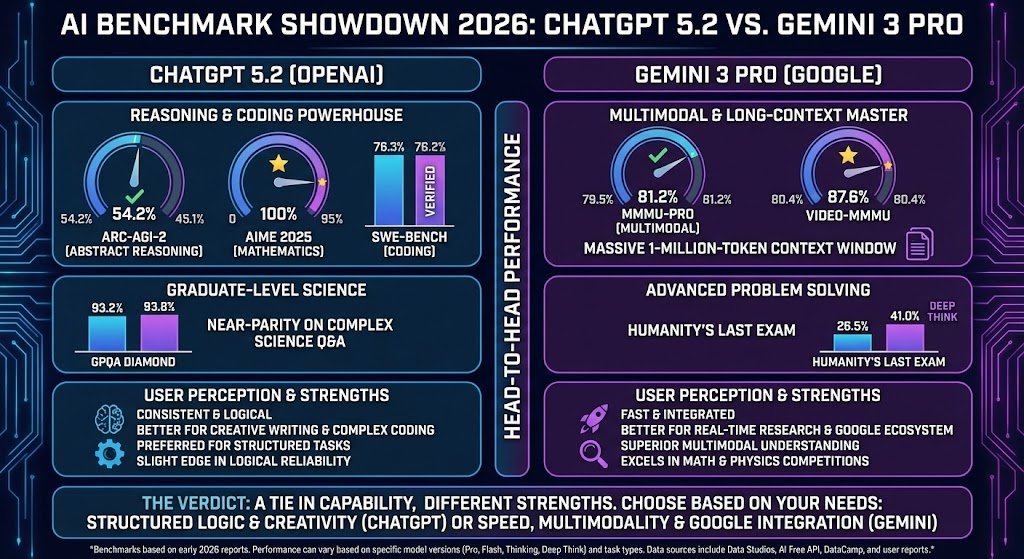
Image Generation & Visual AI
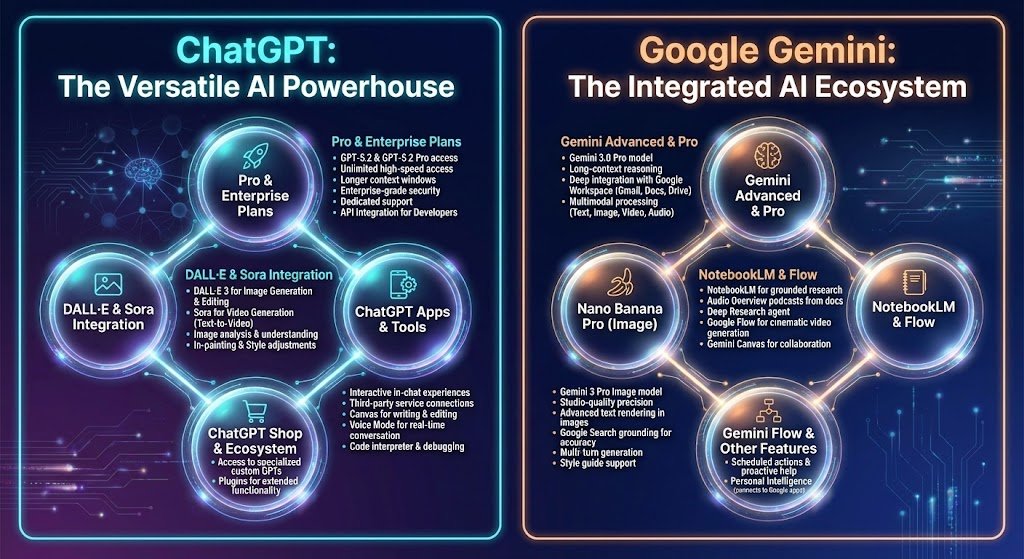
ChatGPT Images (DALL·E + Native Image Tools)
- Strong creative control
- Better prompt understanding
- Consistent styles
- Ideal for marketing visuals
Gemini Images
- Excellent image understanding
- Can analyze diagrams, charts, photos
- Strong for technical visuals
- Can create complex infographics
Nano Banana Pro & Flow
- Gemini’s creative tools like Flow focus on structured design
- ChatGPT focuses on creative freedom
Creative Writing and Content Generation: ChatGPT vs Google Gemini
ChatGPT is widely considered stronger for creative tasks storytelling, essays, blog content, marketing copy, and SEO optimized articles thanks to its conversational tone and ability to craft long, engaging narratives. Gemini’s responses tend to be more concise and factual, which suits technical or business documentation. Users often combine the strengths by researching with Gemini and writing or polishing with ChatGPT.
Coding and Technical Use Cases:: ChatGPT vs Google Gemini
Developers using Gemini 3 Pro find its multimodal coding assistance where screenshots or diagrams can be interpreted particularly helpful for UI tasks and front-end work. ChatGPT’s GPT-5 series models are strong with step-by-step explanations, debugging, and API usage. In real coding comparisons, users note that Gemini produces tighter UI code from visual input while ChatGPT produces highly polished logical code structures.
SEO, Research, and Workflow Optimization: ChatGPT vs Google Gemini
For SEO work and competitive research, Gemini’s integration with Google Search and its Deep Research capabilities provide fast, structured access to current trends, citations, and factual summaries. ChatGPT’s strength is in crafting readable text that satisfies both humans and search engines and adding semantic keyword structures that align with modern SEO practices.
Pricing and Access Models: ChatGPT vs Google Gemini
- ChatGPT Go: Lower-cost tier (~$8/month) with access to GPT-5.2 Instant and limited features. Ads are shown in this tier in the U.S.
- ChatGPT Plus / Pro: Higher tiers grant full access to GPT-5.1 / GPT-5.2 and extended context limits.
- Gemini Free & Advanced: Free tier with limits; paid “Google AI Pro” subscription (~$19.99/month) includes priority access, Deep Research, and personalized features integrated with Google services.f
Usability and Readability: ChatGPT vs Google Gemini
Both systems are designed for broad use from students to professionals. ChatGPT emphasizes conversation and explanation, while Gemini emphasizes concise, data-backed insights. For complex knowledge discovery, Gemini’s structured responses can be easier to reference quickly. For narrative and instructive tasks, ChatGPT’s tone tends to feel more natural and engaging.
ChatGPT Ads vs Google AI Ads
ChatGPT Ads (Emerging)
- Context-based recommendations
- Non-intrusive placements
- AI-assisted ad copy generation
- Personalized user intent matching
Google Gemini + Google Ads
- Deep Search intent data
- Massive advertiser ecosystem
- Performance-driven ad targeting
Data Privacy Notes
Google’s “Personal Intelligence” feature can draw from a user’s connected Google account apps to personalize results, but users must opt in and can control data access. ChatGPT uses user data for context during sessions but does not automatically pull personal data from outside services.
Real-World Use Cases: ChatGPT vs Google Gemini
- Students: Use ChatGPT for study guides and writing. Use Gemini for factual summaries from search data.
- Marketing Professionals: Use ChatGPT for creative SEO content and Gemini for trend research.
- Developers: Use ChatGPT for logic and explanation, Gemini for UI interpretation and multimodal prompts.
- Business Teams: Use Gemini for research dashboards, Google Workspace automation, and structured summaries.
AI Tools:






Leave a comment